What Is the Failure Schema?
Failure schema describes a recurring belief that you have failed, will fail, or are less capable than peers in achievement areas. Work, study and learning a skill can become settings where a particular setback seems to reveal a permanent limit to your ability. This is an educational explanation of a concept in the International Society of Schema Therapy’s model, not a diagnosis.
In a fictional example, Dev receives a note that one section of his report needs more detail. He concludes that he was never cut out for the job. The note concerns one section; his conclusion reaches across his working life. A correction is an event, while a broad judgment about ability is an interpretation added to it.
This guide is for adults who recognize that jump and want a way to examine it. Keep three questions in view: What am I predicting? What practical circumstances need attention? How am I responding? A difficult afternoon, a strong feeling or a questionnaire score alone cannot establish a schema.
Common Signs
These are possible patterns to reflect on, not diagnostic criteria. Their recurrence, context and effect on daily life matter more than counting how many fit.
- Discounting success: treating earlier achievements as luck while allowing one correction to define your ability.
- Broad negative comparison: comparing your current skills with someone more experienced and predicting that you will never catch up.
- Avoiding opportunities: not applying, volunteering or practising because failure seems certain in advance.
- Giving up after difficulty: interpreting a learning problem as a fixed limit rather than something that may need time or support.
- Trying to disprove inadequacy: overworking or repeatedly checking to make criticism seem impossible.
Delay, fatigue or extra effort has many possible explanations. The University of Maryland Counseling Center’s procrastination resource describes uncertainty, stress and concerns about evaluation among possible reasons for postponing tasks. Procrastination does not reveal a hidden schema on its own.
Fictional Everyday Examples
At work: Priya has delivered accurate reports for a year. One comes back with comments about structure. By evening, her earlier work no longer seems to count, and that single document has become the measure of her competence. The feedback may be useful without supporting that broader conclusion.
In study: Nora, an adult learner, receives feedback that two source dates are missing from an assignment. The citation style is new and caring responsibilities have limited her study time. She predicts that she will never finish the qualification. The worksheet below separates that prediction from the feedback and practical circumstances.
In everyday learning: Lena compares her first pottery bowl with the work of someone who has practised for years. She stops attending because another session feels pointless. The comparison leaves out experience and opportunities to learn.
Missing training, unclear instructions, limited resources, health, discrimination or competing responsibilities can affect performance. Feedback can also be accurate. Examining a recurring failure expectation means asking whether the conclusion reaches further than the evidence supports, while giving real barriers practical attention.
Failure vs. Defectiveness and Unrelenting Standards
The 18-schema overview places Failure among patterns concerning autonomy and achievement. Several meanings can attach to the same event, such as a tutor’s comment or a manager’s edit. Compare the concern, rather than assigning a label from the behavior alone.
| Pattern | Main concern | Possible added meaning |
|---|---|---|
| Failure | Expected achievement or competence | “I will never manage work like this.” |
| Defectiveness/Shame | Personal acceptability | “This mistake proves I am unacceptable.” |
| Unrelenting Standards | Demanding internal rules | “I must never need correction.” |
| Ordinary learning uncertainty | A particular unfamiliar task | “I have not learned this method yet.” |
“I need practice with this skill” may be accurate. “I am incapable” generalizes across tasks, while “I am unacceptable” shifts to personal worth. The Defectiveness/Shame guide explores that distinction. Unrelenting Standards concerns demanding rules, which can occur with or without an expectation of failing. These themes can overlap; the table cannot establish which, if any, applies to you.
How Perfectionism Can Keep Self-Worth Conditional
Failure predictions, perfectionistic rules and shame can occur together, separately or not at all. The ISST description of coping styles distinguishes surrender, avoidance and overcompensation. A person can respond differently across situations; these are not fixed personality types.
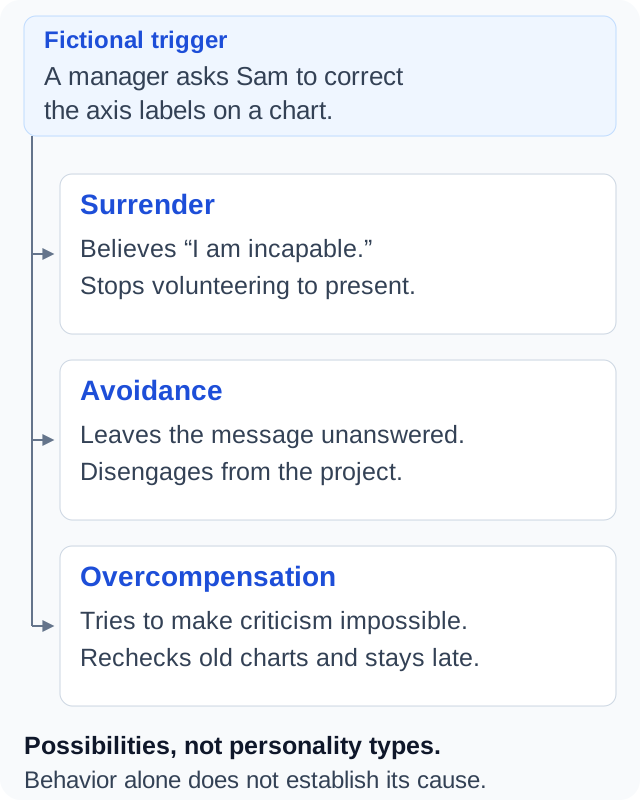
Consider one fictional trigger: Sam’s manager asks him to correct the axis labels on a chart before a meeting. The painful prediction is that he is broadly incapable. Three possible responses follow:
- Surrender: Sam accepts the prediction as true, decides he cannot be trusted with presentations and stops volunteering.
- Avoidance: Sam leaves the message unanswered for two days and disengages from the project, keeping away from both the task and the feelings it brings up.
- Overcompensation: Sam corrects the labels, then rechecks past charts and stays late in an effort to make any further criticism impossible.
The same outward behavior can have other motives. Asking a colleague to check a chart may be a sensible requirement of the task; it is not automatically overcompensation. Observing a response does not establish its cause or reveal another person’s thoughts.
The Centre for Clinical Interventions’ explanation of perfectionism describes how meeting a demanding standard can lead to raising it again. When self-worth depends heavily on achievement, completion may bring only brief relief.
A 2024 systematic review and meta-analysis associated perfectionistic concerns with lower self-esteem in adults. Its cross-sectional evidence could not establish causality. It does not prove that perfectionism causes a Failure schema or explain any individual reaction to feedback.
A Worked Reflection: Feedback Without a Verdict on Worth
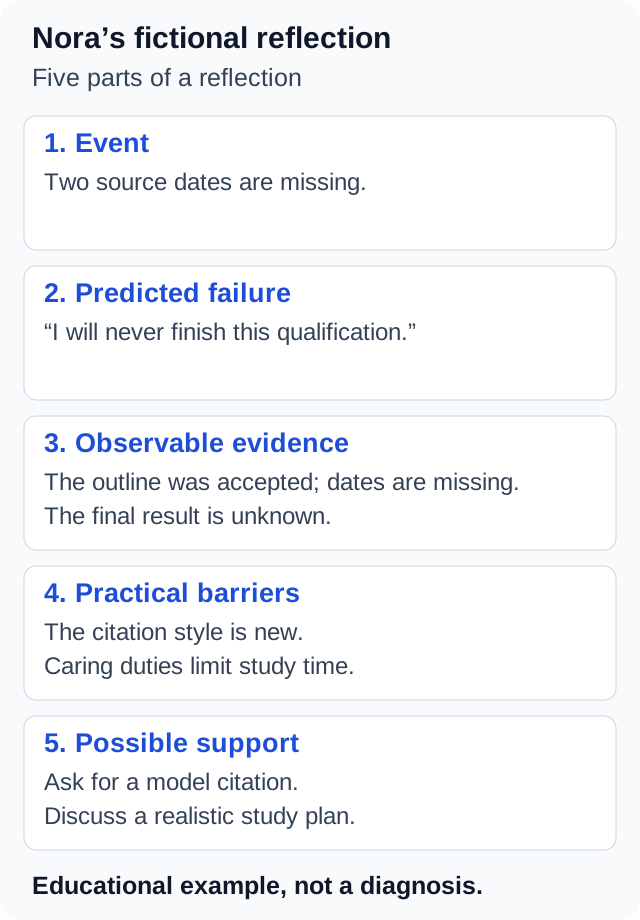
This optional worksheet is an original educational writing aid, not a validated assessment or treatment protocol. It separates five things: the event, the predicted failure, observable evidence, practical barriers and possible support. Use one manageable situation and leave any prompt blank if you prefer.
Nora’s completed example is fictional, not a patient account or a treatment outcome. The feedback asks for two missing source dates; it does not predict her final course result.
| Field | Reflection prompt | Completed fictional example |
|---|---|---|
| 1. Event | What happened, without a conclusion about me? | A tutor marked two source dates as missing. |
| 2. Predicted failure | What am I predicting about the task or my future ability? | “I will never finish this qualification.” |
| 3. Evidence | What supports or limits the prediction? What is unknown? | Two dates are missing; the outline was accepted. The final result is unknown. |
| 4. Practical barriers | What skill, time, access, health or circumstance needs attention? | The citation style is new. Caring responsibilities limited study time. |
| 5. Possible support | What clarification, practice, resource, accommodation or boundary might help? | Ask for a model citation and discuss a realistic study plan. |
Support may not be immediately available. “I do not know who to ask yet” is a valid entry and identifies an unmet need. The worksheet should not turn a real lack of access into another personal failing.
Review your notes: Is row 2 a task prediction or a judgment of worth? “This mistake proves I am unacceptable” concerns personal acceptability, whereas “I will never finish” predicts achievement. What remains unknown in row 3? What small action addresses the actual feedback? Nora could correct the two dates and clarify the submission requirements. That step cannot guarantee her final grade, mood or change in belief.
Practice Flexible Standards Without Abandoning Care
Match the next step to the need you identified. If instructions are unclear, ask what “complete” means. If a method is new, arrange practice or a model answer. If circumstances limit your capacity, consider workload, rest, accessibility support or a boundary. Not every problem is solved by changing a belief.
For a low-stakes task, an optional stopping rule may help you examine repeated checking. A routine personal email might need one draft and one check of the recipient, information and tone. Consider stopping when those requirements are met. This is not advice to make deliberate mistakes or reduce necessary checks where accuracy protects safety, consent or another person’s welfare.
The University of Maryland Counseling Center’s perfectionism guidance supports high standards that remain achievable. Relationships, rest and interests need not become replacement tests of worth. Returning to pottery can be about participating, rather than deciding what every bowl proves about your talent.
If you want to compare broader themes, the free Schema Reflect Inventory provides an educational profile across 18 schemas. It has not been clinically validated; its scores cannot diagnose, establish a childhood cause or determine treatment. Read how SRI results and missing answers work before interpreting a profile.
Pause if reflection becomes overwhelming. If distress persists or affects daily functioning, consider qualified support. Concrete situations and questions can provide more useful context for that conversation than a schema label alone.
FAQ
Is Failure schema the same as fear of failure?
No. Fear about a particular task can reflect difficulty, uncertainty or real consequences. Failure schema describes a broader recurring expectation of inadequacy in achievement. One anxious moment does not establish it.
Can a successful person recognize a failure pattern?
Yes. Someone may dismiss achievements while treating a correction as proof of inadequacy. Success or self-doubt alone does not establish a schema; examine how the person interprets events alongside the full context.
How is Failure schema different from perfectionism?
Failure concerns expected competence; Unrelenting Standards concerns demanding rules. Perfectionistic checking may accompany a failure prediction, but the behavior cannot identify the underlying pattern. They can overlap or occur separately.
Does procrastination always indicate Failure schema?
No. Unclear expectations, stress, fatigue, competing demands and missing resources can all affect starting. Examine practical conditions as well as the meaning attached to the task.
Sources and Further Reading
- International Society of Schema Therapy: central concepts and schema definitions and coping styles. Sources for terminology; the fictional examples and worksheet are educational material created for this guide.
- Centre for Clinical Interventions: What Maintains Perfectionism (PDF) and perfectionism self-help resources.
- University of Maryland Counseling Center: Perfectionism and Low Self-Esteem and Time Management and Procrastination.
- Khossousi and colleagues (2024): The relationship between perfectionism and self-esteem in adults: a systematic review and meta-analysis. Association, not proof of causation or validation of this worksheet.
- Schema Reflect editorial methodology: source selection and the limits of our educational tools.