Schema Modes: Vulnerable Child, Protector and Healthy Adult
Understand Vulnerable Child, Detached Protector and Healthy Adult through a worked example, labeled diagrams and a reflection sheet without scores.
Schema modes describe emotional states and coping responses active at a particular moment. They can help describe a shift from feeling hurt to shutting down, or finding a way to care for yourself while addressing a problem. They are not personality types or a verdict about who you are.
This guide follows three examples: Vulnerable Child, Detached Protector, and Healthy Adult. They are part of a broader model, not the only three modes. The International Society of Schema Therapy (ISST) introduces modes as moment-to-moment states. Our introduction to schema therapy explains the wider therapeutic approach.
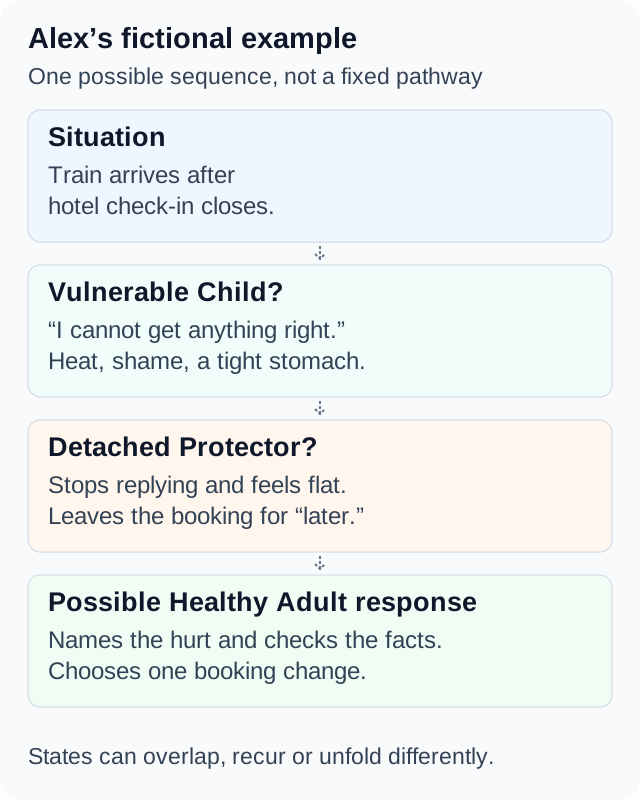
Alex, the person in our example, is fictional. Alex and a friend are planning a weekend trip over text. The friend spots a timing problem: hotel check-in closes before Alex’s train arrives. Alex feels a hot flush of shame, then wants to put the phone face down and stop dealing with it. We will follow that experience without assuming one exchange reveals a schema, a diagnosis, or a childhood history.
Where These Modes Fit
A schema is an enduring pattern of meaning, feelings and expectations. A coping style describes a way of responding to schema activation. A mode describes the state active now. Our guide to schemas and coping styles compares surrender, avoidance and overcompensation; here, the focus is on changing states around one event.
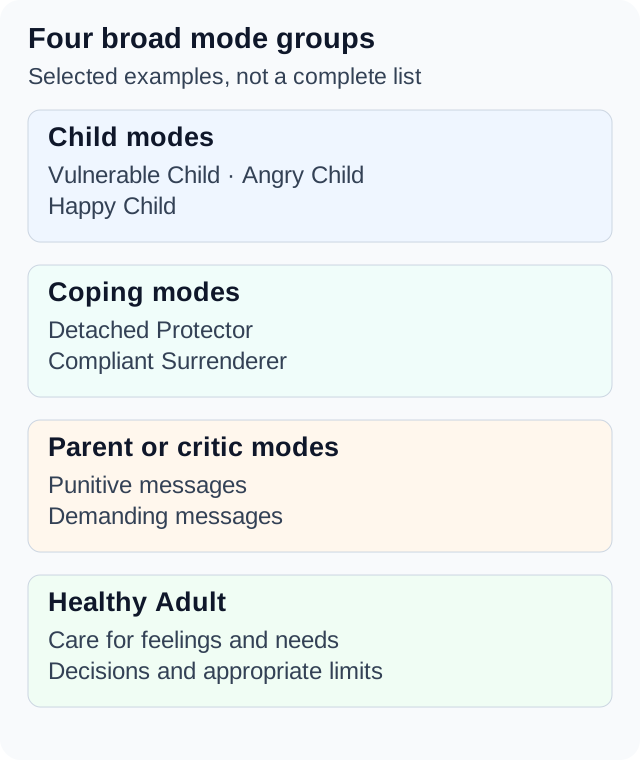
Edwards’s 2022 clinical framework groups modes under four broad headings. The following map is introductory; it does not list every mode or relationship described in that framework.
- Child modes: emotional states such as Vulnerable Child, Angry Child and Happy Child. This group includes painful feelings and positive experiences such as play and contentment.
- Coping modes: states organized around managing emotional pain. Detached Protector involves distancing; Compliant Surrenderer involves going along with others.
- Parent or critic modes: internalized critical or demanding messages. The model’s “parent” label does not establish what any particular caregiver did.
- Healthy Adult: attending to feelings and needs while making decisions and setting appropriate limits.
The 18-schema overview describes enduring patterns. Eighteen is a count of schemas in that model, not a count of modes. You do not need to choose a schema before noticing what happens during a difficult moment.
Vulnerable Child: Notice the Hurt
The Schema Therapy Institute Australia’s guide describes Vulnerable Child in terms of feelings such as fear, shame, loneliness, rejection, helplessness and sadness. “Child” is model terminology for a vulnerable emotional state; an adult does not literally become a child.
In Alex’s case, the message describes a narrow problem: arrival and check-in times conflict. The interpretation arriving with the shame is much broader: “I cannot get anything right.” Alex notices heat in the face, a tight stomach, an urge to apologize repeatedly, and worry that the friend now sees the whole trip as a burden.
These are possible observations from inside the experience. They are not visible signs that confirm a mode from outside. The friend cannot identify Alex’s internal state just from a delayed reply, and Alex’s shame alone does not establish a Defectiveness schema.
What needs attention? Alex might want reassurance that the friendship is intact, acceptance of an ordinary mistake, or practical help changing a booking. These are tentative possibilities. Alex could ask, “Can we look at the options together?” without first deciding whether a mode label fits.
Hurt can arrive alongside other reactions. Alex might feel angry about the friend’s phrasing or hear an inner message such as “you always mess this up.” The model offers other mode language for anger and self-criticism. For reflection, it may be enough to record the actual feeling and thought instead of trying to settle every label.
Detached Protector: Notice the Distance
The Jeffrey Young Schema Therapy Association’s educational overview describes Detached Protector as shutting down emotional experience to avoid pain. This points to a possible protective function, rather than defining someone by an outward behavior.
In Alex’s fictional sequence, shame gives way to flatness. The phone goes face down. Alex opens another app, feels oddly calm, and leaves the booking problem for “later” without deciding when later is. Emotional distance may be keeping the sting of shame away.
Silence alone tells the friend little. People delay replies because they are busy, want time to think, or prefer to answer after finding a solution. Taking a break, being introverted and using a screen are ordinary activities. None identifies Detached Protector on its own.
A chosen pause can feel different. Alex could step away, allow the embarrassment to settle, and plan to return after dinner. Protective distance might instead leave both the feeling and the practical problem out of view. These examples are prompts for noticing the experience, not a validated checklist for separating states.
Short-term distance can bring relief. A possible later cost is that the bookings remain unresolved and the friend starts wondering whether Alex still wants to go. Neither outcome is inevitable. The useful question is what the distance does in this situation, rather than whether Alex is “an avoidant person.”
Healthy Adult: Care and Limits Together
Healthy Adult includes responding to vulnerability and setting limits, as described in STIA’s overview. It need not feel perfectly calm. In our example, Alex can remain embarrassed, angry or uncertain while acknowledging the hurt and addressing the booking problem.
A possible internal response is: “I feel embarrassed. The timing needs correcting, but this mistake does not define my worth.” Three small actions could follow:
- Acknowledge the feeling. “That message stung, and I feel exposed.” Alex gives the feeling room without treating it as proof of personal failure.
- Check the situation. The friend pointed out a conflict between arrival and check-in. The message did not say Alex is useless or that the whole trip is ruined.
- Choose a proportionate action. “Thanks for spotting the clash. Let’s see which booking we can move.” If the delivery was sarcastic, Alex could add, “I’d rather we sort this out without the sarcasm.”
Healthy Adult can include disagreement, asking for help and boundaries. Someone else’s harmful behavior remains their responsibility. Reflecting on your reaction should not become a reason to accept mistreatment or stay in an unsafe situation.
Alex may still feel distressed after replying. These steps illustrate a possible response, not a guaranteed switch between modes or a treatment outcome. A 2026 review found that empirical research specifically into mechanisms of mode activation remains limited. Our example is not a universal sequence.
Track One Moment Without Scoring Yourself
This educational reflection sheet separates an event from feelings, thoughts, responses and possible needs. Copy the headings into a note if useful. The completed row records Alex’s example; it produces no score.
| Situation | Feelings | Thoughts | Response | Possible need |
|---|---|---|---|---|
| Friend points out that the train arrives after hotel check-in closes. | Embarrassment and shame. | “They will think I am useless.” | Stopped replying and felt disconnected. | Reassurance, respectful communication, and time to correct the booking. |
Keep observable events in the situation column and interpretations in the thoughts column. “Friend pointed out a timing problem” is an event; “they will think I am useless” is an interpretation. Treat the need as something to consider. A mode label is optional: note “possibly Vulnerable Child, then Detached Protector” or leave it out.
One entry cannot establish a dominant mode. If the exercise feels manageable, record another ordinary interaction later in the week. Look for specific observations, not a total for each label. You can revise an interpretation when new information arrives, or simply write “not sure.”
You do not need to analyze every experience in a day. Start with one episode you can recall without excessive strain, then return to ordinary activities. If you do not notice a clear change of state, that is also an observation: you do not need to create a sequence just because the example contains one.
Return to the specific problem
A useful follow-up note describes what happened next. Suppose Alex returns after dinner, checks the hotel’s booking terms and asks about a later arrival. The friend answers, “I only meant we should check the times.” Alex can record that new information without pretending the earlier shame never happened. The original feeling and the later clarification can both belong in the account.
It also helps to separate an action from its result. Alex might make a respectful request and still find that the hotel cannot change the reservation. An inconvenient outcome does not prove the response was wrong or that Alex failed to reach Healthy Adult. The practical next step could be comparing a different train with a different hotel, while acknowledging frustration about the extra work.
If you bring the entry to therapy, you could ask: “I noticed shame, then flatness. Does this language help describe what happened?” Or: “I called it a break, but I never returned to the conversation. What might I have needed?” Those questions leave room for a different explanation. A therapist may help explore context that a single row cannot capture.
You can also keep the entry entirely in ordinary language. “I felt hurt, disconnected, and later able to ask for help” may be more useful than a precise-sounding label you are unsure about. The purpose is a clearer account of one interaction and a possible next action.
Stay with what happened, what you felt and what you might say next time. The sheet does not ask you to recover memories or attempt imagery, chair work or intensive mode work alone. Bring those activities to a qualified therapist.
How This Differs From the SMI and SRI
The Schema Mode Inventory (SMI) is a separately developed questionnaire. A 2010 study of its short form examined its measurement properties. That evidence does not validate this informal sheet, which has no thresholds, severity bands or diagnostic interpretation.
Our Schema Reflect Inventory (SRI) compares agreement with 144 statements grouped into 18 schema themes. It does not measure schema modes. SRI has not been clinically validated; its scores are prompts for self-reflection, not clinical findings. Neither this article nor the sheet provides a clinical assessment.
Stop the exercise if it becomes overwhelming. If distress is persistent, severe, disruptive or hard to manage, contact a qualified mental health professional. If you already work with a therapist, one completed entry can provide a concrete starting point for discussing a difficult interaction.
Sources and Further Reading
- ISST: Schema Therapy Central Concepts — introductory definitions.
- Edwards (2022): Using Schema Modes for Case Conceptualization in Schema Therapy — a clinical framework and mode groups.
- Schema Therapy Institute Australia: A Plain English Guide — educational descriptions of modes.
- Jeffrey Young Schema Therapy Association: Schema Therapy — educational overview of the model.
- Lobbestael and colleagues (2010): Reliability and Validity of the Short Schema Mode Inventory — research on a separate instrument.
- Krans, Hilgefort and Lobbestael (2026): Experimental Research on Schema Modes — activation research and its limitations.
Continue exploring
- What Is Schema Therapy? How It Works and HelpsLearn what schema therapy is, how it works, and how to use it to change repeating emotional loops. Includes practical tools, evidence-based benefits, and FAQ.
- Maladaptive Schemas vs. Coping Styles: Differences and ExamplesCompare schemas, coping styles and modes through one fictional example. Explore surrender, avoidance and overcompensation, plus a reflection worksheet and FAQ.
- 18 Early Maladaptive Schemas: Complete ListExplore all 18 early maladaptive schemas, their five domains, common signs, and how schema patterns shape thoughts, emotions, and relationships.
- Schema Reflect Inventory: Scoring, Results and LimitsUnderstand SRI scores with a worked example: 144 items, 18 schemas, missing answers, edited wording, privacy, and the limits of this educational inventory.
Start free schema test
Allow about 20–30 minutes. No registration required. Your answers stay in your browser.
See your 18-schema profile